Latest Post
Showing posts with label Navy. Show all posts

Need to buy new ships, aircraft

LIMA EXHIBITION: PM says govt has identified maritime and aerospace industries as key sectors to support


Prime Minister Datuk Seri Najib Razak (second from right), his deputy, Tan Sri Muhyidddin Yassin, and Datin Seri Rosmah Mansor at the 12th Langkawi International Maritime and Aerospace exhibition in Langkawi. Pic by Effendy Rashid

LANGKAWI: THE Langkawi International Maritime and Aerospace exhibition is poised to become a gateway for defence spending by the Asian market, Datuk Seri Najib Razak said yesterday.

The prime minister said the exhibition was well situated to take advantage of the growth in military spending in Southeast Asia which went up by 13.5 per cent last year, with Asian defence spending set to overtake Europe for the first time.

"Military modernisation programmes continue to drive defence spending in Asean. (The) acquisition of ships and aircraft, drones and armoured vehicles will continue to be the focus of procurement within the region and form the majority of defence procurement spending until 2020," he said when launching the 12th Langkawi International Maritime and Aero-space exhibition (Lima 2013) here.

Najib said Lima was important for Malaysia as the government had identified the maritime and aerospace industries as key sectors for investment and support.

He said the launch of the Malaysian Shipbuilding/Ship Repair Industry Strategic Plan 2020 at the last edition of Lima and the recent inclusion of the industry in the Economic Transformation Programme were clear acknowledgement of its importance, not just in accelerating Malaysia's growth but also in providing high-income jobs.

"We have also pushed aviation to the centre of our industrial policy. Through the Malaysian Aerospace Council, we have steered the development of the aviation industry."

Najib said the aviation industry had grown from RM8.2 billion in turnover in 1998 to RM30 billion, with more than 230 active companies and a workforce of 65,000.

Last year, he said the aerospace industry recorded RM2.3 billion in investments, creating 2,700 new jobs.

"Situated as we are in the heart of one of the most vibrant maritime and aerospace markets, with strong connections to Asia and an open business-friendly economy, I believe the future prospects for growth are strong."

As expected, Najib began his speech by touching on what must have been on his mind for the last month or so -- the intrusion in Sabah by gunmen.

"I stand before you today in unique circumstances. I have served as defence minister, as deputy prime minister and now as prime minister. I have spoken at this exhibition and others like it but this is the first time I have done so while an internal security situation is ongoing.

"Six weeks ago, a group of armed militants landed on Borneo's eastern shore pursuing a grandiose territorial claim that is without merit or basis in fact.

"It was the beginning of the biggest internal security threat since the communist insurgency ended in 1989."

As former defence minister, he said he had made big decisions on defence procurement and policy and advised forces and companies on spending and strategies.

"These were big questions. They involved potential loss of life and deployment of national resources," he said, mentioning the country's decision to send troops on peacekeeping missions under the United Nations' umbrella to places like Bosnia, Somalia and Lebanon.

Nothing, he said could adequately prepare someone for a situation like the Sabah incursion.

"I urge the men and women currently on duty in Sabah to remain steadfast and vigilant. Our prayers are with you always."

Najib also paid tribute to those who had fallen in Ops Daulat in Lahad Datu and Semporna, adding that it was the responsibility of the government to ensure that its security forces were provided the best equipment the country could afford and to show that the lives lost in protecting Malaysia's sovereignty were not lost in vain.

"You shall not be forgotten."

Yesterday's opening ceremony was held on the tarmac of the Langkawi International Airport, the first time since Lima's inception in 1991.

The ceremony was followed by a short show by 22 Royal Malaysian Air Force -- the F-5E Tiger, MiG-29N Fulcrum, Sukhoi SU-30MKM, Boeing F/A-18D Hornet, BAE Systems Hawk and Aermacchi jets and Eurocopter EC-725 Cougar helicopters.


Malaysia’s Krisakti aerobatics team going through its routine over the Mahsuri International Exhibition Centre on the first day of the Lima exhibition yesterday. On the tarmac are Dassault Rafale multirole fighters of France’s Armee de l’Air.

Read more New Straits Times
 

The Rise of Teguh Samudera

RMN’s second training ship, the Teguh Samudera (Firm Ocean) was recently launched by Tun Dr Siti Hasmah Mohd Ali, the wife of former Prime Minister, Tun Dr Mahathir Mohamad at NGV Tech shipyard in Sijangkang, Banting, Selangor on February 27.
049170adc64405b084a19d94bdaa1c8f_L


This was the second launch for RMN’s latest Samudera class training ships after Gagah Samudera (Mighty Ocean), the lead ship was launched by the Datin Seri Rosmah Mansur, the wife of the current Prime Minister, Datuk Seri Najib Tun Razak on December 14, 2012. (here)

Both the Gagah Samudera and Teguh Samudera are 75.9 meters long, have a helicopter deck as well as capable of operating up to 2,500 nautical miles non-stop for 21 days. 47 crews are needed to operate the ships. Beside the crews, both ships are able to accomodate 60 trainees on board including a specialised compartment for female whom 12 could be brought along.

DSC_7515DSC_7532DSC_7541DSC_7557DSC_7584DSC_7648
The ships are also equipped with combat system, radar, navigational and communication equipment as well as close-in weapons enabling them to conduct limited combat operation beside their primary training role.

Unlike the Gagah Samudera which hull blocks were built by DSME at its facility in South Korea, the Teguh Samudera was wholly built by NGV Tech. The keel laying works were conducted on January 10 and its takes just 56 days after the works to complete and launch the vessel. Teguh Samudera will be officially handed over to the RMN on June 21, 2013.

The RMN Chief of Staff has taken this opportunity to proposed to the Government for conducting a follow up procurement of additional two of such vessel in the future to fulfill the RMN’s requirement for four training vessels.

In conjunction with the launching ceremony, Tun Dr Mahathir, one of Malaysia’s advocate on local maritime industries also took the chance to look at the progress of Gagah Samudera which is currently undergoing fitting works at NGV Tech’s facility.
DSC_5382DSC_7345DSC_7365DSC_7417DSC_7419
source Malaysia Flying Herald
 

MALAYSIA IS A COUNTRY SPLIT INTO TWO HALVES


Malaysia is a country split into two halves: Peninsular Malaysia and East Malaysia - which are separated by a large body of water, much of which is controlled by neighbouring countries. The Royal Malaysian Navy’s (RMN) shape and mission has been largely determined by this factor - along with the circumstance that Malaysia controls one half of the vital Straits of Malacca. This is reflected in the operational command organization of the RMN.

The RMN has three operational area commands overseen by Fleet Command headquartered at RMN Lumut, with an independent Submarine Command reporting directly to the Chief of Navy. The three major operational commands are, firstly: COMNAV I, located at RMN Kuantan. This is responsible for the East Coast of Peninsular Malaysia and the South China Sea portion of it including Malaysia’s 200-mile EEZ claims there, along with the waters along the Singapore Straits. COMNAV II, located at RMN Sepanggar, is responsible for the entire coastline and waters of the East Malaysian states of Sabah and Sarawak plus the various seas surrounding them which form part of Malaysia’s 200 mile EEZ claims. Finally, COMNAV III, located at RMN Langkawi, is responsible for the West Coast of Peninsular Malaysia and the Malacca Straits.
The RMN splits some of its surface ships evenly between the three area commands while others are deployed to areas depending on operational or training requirements. The navy’s two submarines are permanently stationed at RMN Sepanggar in the COMNAV II area of operations with Submarine Command also based at RMN Sepanggar. Submarine Command has not only the responsibility for the operations of both the RMN submarines but also in regard to the training of personnel for them. Following an initial blitz of publicity to offset media reports on maintenance issues in regard to the two Scorpene class boats, the RMN has drawn a tight veil over the operations and exercise participation. The submarines will continue to be a source of controversy in Malaysia - owing to issues surrounding the circumstances of their purchase and a subsequent murder linked to it.
While all three naval commands are of importance, COMNAV II is seen as the major operational challenge. This is because the East Malaysian state of Sabah, whose waters fall under COMNAV II, faces the South China Sea, the Sulu Sea and the Celebes Sea. Additionally, COMNAV II’s portion of the South China Sea includes the disputed Spratly Islands. Malaysia currently maintains 5 military outposts there, the largest being Naval Station Lima on Swallow Reef. Various works undertaken since its initial occupation in 1983 has led to the reef becoming an island about 7.3km long and 2.2km wide. It has a land area of around 6 hectares with a runway capable of supporting C-130 transport aircraft and a dock allowing the RMN’s patrol craft to operate from there. Since 1999 Malaysia has not added any additional outposts in the Spratlys beyond the five established there. The Spratlys and the South China Sea around them are known to the RMN as the “Gugusan Semarang Peninjau” (GSP) operational area, which roughly translates to “Frontier Reconnaissance Island Chain” in English.
Currently the RMN has only one overseas operational mission, namely “Operation Fajar” - an ongoing task to escort merchant shipping belonging to the Malaysian International Shipping Corporation through the pirate-infested waters near the Gulf of Aden. The mission was sparked by the seizure of two MISC vessels in September 2008 by pirates and since then the RMN has been carrying an indefinite anti-piracy escort mission in the region. Initially these escort missions were carried out by ships from the RMN fleet, but the costs along with the wear and tear on them led to the RMN working with MISC to provide an alternate solution in the form of a converted MISC merchantman to function as a naval auxiliary ship.
To perform this mission, the container ship Bunga Mas Lima was converted to a RMN auxiliary ship on 1 June 2009. The modifications to the 699 TEU vessel (owned by MISC) included the installation of a helicopter landing dock, light weapons mounts, military grade communications and medical facilities, the ability to launch RMN’s small craft and a repainting of the ship to RMN’s colours. MISC personnel commissioned as Naval reservists formed the ship’s crew while a combined special forces team drawn from all three services of the Malaysian Armed Forces along with a medical team and an RMN naval helicopter detachment with a single helicopter were also stationed on the ship. The success of this led to the acquisition of a second naval auxiliary, the Bunga Mas 6 being launched in August 2011 to operate simultaneously in the region with the Bunga Mas 5. The roles were one ship escorting westbound shipping while the other will escort eastbound shipping - however budgetary and operational constraints prevented the RMN from having an additional helicopter detachment to operate in the region. Thus the RMN’s sole helicopter in the area was deployed on one or the other ship depending on requirements. Recently though, as a result of the number of piracy attacks declining in the Gulf of Aden, the RMN has scaled back the presence of the auxiliary ships to a single vessel deployment on a rotational basis rather than both ships being simultaneously deployed in the region.
At the time of writing, Malaysia is engaged in a potentially violent standoff with Philippines militants in the East Malaysian state of Sabah, who appeared to have infiltrated the state by sea. As a consequence, it is expected that there will be an effort to beef up the RMN’s riverine and coastal waters capabilities. The RMN currently operates some 17 CB-90 combat boats bought in the late 90s - but there may be plans to bolster this fleet in light of this latest confrontation.
Also ongoing tensions in the South China Sea, particularly involving the disputed Spratly Islands, are expected to add to the RMN’s burden since the Navy is responsible for maintaining Malaysia’s presence in the disputed areas. Given that the area that it has to cover, the RMN’s relatively small fleet size of around 40 ships seems inadequate to meet all its operational tasks. Budget issues and the lack of priority by the Malaysian government over the years has made fleet development difficult.
The cancelled Batch 2 Lekiu class frigates are a good example of this. In 2006 the Malaysian government had signed a letter of intent with BAE Systems for the construction of two follow-on ships to the existing two Lekiu class frigates already in service in the RMN. The Batch 2 ships were to be built locally on the island of Labuan at the Labuan Shipyard and Engineering dockyard. However in August 2009, it was reported that both the Malaysian government and BAE Systems had reached an agreement not to continue with the deal due to cost-cutting measures.
With the cancellation of the Batch 2 Lekius, the RMN is expected to have to settle for a possible upgrade and Service Life Extension Program (SLEP) of the existing two Lekius - though no funding has been allocated publicly for that. Similarly an upgrade and SLEP of the 4 Laksamana class corvettes is also expected to be carried out. Originally built in Italy for the Iraqi Navy as the Assad class but impounded following the Iraqi invasion of Kuwait, two of the ships were purchased by Malaysia in 1995 and the remaining two in 1997.
The Malaysian government has provided funding for one of the Royal Malaysian Navy’s key programs, the six ship Second Generation Patrol Vessel – Littoral Combat Ship (SGPV-LCS). The SGPV-LCS are meant to be the follow-on to the six Kedah class Next Generation Patrol Vessels (NGPV) built by Boustead Naval Shipyard (BNS). The SGPV-LCS will be bigger and more heavily armed compared to the Kedah’s. Despite the LCS name, the SGPV-LCS is a conventional design hull based on DCNS’s Gowind design, with the French shipbuilder being selected as the foreign partner to work with BNS on the SGPV-LCS program.
The ship is to have an overall length of 107m, a full load of 2750 tons, a 106 personnel crew, maximum speed of 28 knots with a cruising speed of 16 knots. The range of the ship is expected to be 5000NM with an endurance of 21 days and will have a hangar and flight dock for a single helicopter. The weapon systems of the SGPV-LCS have been a source of continuing disagreement between the RMN and Malaysian government. The RMN is insisting that the ships be outfitted their exact choice while the government has pressed for systems that are cheaper than what the navy wants. The RMN is said to prefer the Raytheon ESSM for the surface to air missile with the Kongsberg Defence & Aerospace Naval Strike Missile for the surface-to-surface weapon.
However, the government prefers the Mica system for the SGPV-LCS’s SAM and the MBDA’s Exocet as it’s SSM. The main gun is expected to be the BAE Systems Bofors Mk3 57mm, with which BNS’s parent company, Boustead Heavy Industry Corporation has an existing joint venture partnership known as BHIC Bofors Asia. The first ship is scheduled to be delivered in 2017, with subsequent vessels delivered every six months thereafter. All will be built at the BNS facilities in Lumut. Nevertheless, with this ship class only to be delivered beginning from 2017, it is clear that the RMN will face a capability gap till then. There has been moves by the US to offer surplus Perry class frigates being decommissioned from the US Navy to meet the capability gap though little has emerged from this to date. This is partly because any such acceptance would require funding approval from the Malaysian government, which has appeared to have put any defence decision involving money on hold until after the election. Though the design and manufacture of equipment are different from other RMN ships, the Perrys would help the RMN in preparing crews for the SGPV-LCS as their capabilities in air, surface and anti-submarine warfare matches the SGPV-LCS mission profile and capabilities.
The RMN has launched two 79.5m locally manufactured training ships in December 2012 and February this year. These have been built jointly by Malaysian company NGV Tech with assistance from South Korea’s Daewoo Shipbuilding and Marine Engineering under a MYR294 million (US $96.1 million) contract signed in 2011. Both ships, named ‘Gagah Samudera’ and ‘Teguh Samudera’ will be commissioned later this year. Each is armed with a 30mm main gun and will have a helicopter dock but no hangar. They will carry a complement of 45 personnel along with 60 trainees. In his speech at the launch of the ‘ Teguh Samudera’ in Febuary this year, RMN Chief Admiral Tan Sri Aziz Jaafar urged the Malaysian government to consider the purchase of two additional training ships. He recommended this occur during the timeframe of the 11th Malaysia Plan of 2016-2020. He asked for additional ships based on the same design but configured as combat ships as replacements for the current 8 aging Handalan and Perdana class Fast Attack Craft, which entered service in the 1970s.
Meantime, the RMN’s multi-purpose, command and support ship (MPCSS) requirement - which was originally scheduled to be implemented in the time frame of the 8th Malaysia Plan (2001-2005) - has yet to be realized. This is despite the loss to a fire in 2009 of the Royal Malaysian Navy’s sole amphibious operation capable ship, the Newport class LST KD Sri Inderapura. The purchase of the Multi-Purpose Support Ship is now unlikely to commence until the 11th Malaysia Plan of 2016-2020. Various companies - including Navantia and DSME - have been proposing their designs to meet this requirement. Malaysia’s initial requirements have been said to be a three-ship class capable of carrying a combined arms battalion and four medium lift helicopters.
Also likely to take place in the timeframe of the 11th Malaysia Plan of 2016-2020, though the RMN would like to have it commence as soon as possible, is the purchase of at least 6-12 anti-submarine warfare helicopters. These will supplement the RMN Naval Air Wing which current consists of six Augusta Westland Super Lynx and six Eurocopter Fennecs. The US has been heavily promoting the MH-60R Seahawk for this requirement - though there has been talk of a navalized Eurocopter EC-725. This latter choice would ensure some compatibility of logistics and maintenance with the RMAF’s existing EC-725 fleet. The main issues the RMN has in regard to the MH-60R are the manpower requirements for the aircraft’s maintenance and support team and also cost. However, the helicopter does meet all the RMN’s requirements and the issue of cost stems more from the funding available to the Malaysian government for such a purchase than the actual price of the helicopters themselves.
Further into the future is the requirement for new Minehunters to replace the Mahamiru class (Italian Lerici class), which have been in service since 1985 - though a SLEP program was carried out by Thales in the mid-2000s. Again although the RMN have listed the replacement of the minehunters on their requirement list, no funding have been specifically allocated for it.
The Maritime Patrol Aircraft function is carried out by the Royal Malaysian Air Force with four Beechcraft 200T. The navy is happy to continue with this mission carried out by the RMAF, and both services have been jointly pushing for a new long range MPA which will carry a combined RMAF/RMN crew - though the aircraft will be part of the RMAF’s fleet. The US has been marketing the Northrop Grumman E-2D for this requirement - though again both the RMN and RMAF have been stymied for lack of funds.
Ongoing funding issues are likely to remain the greatest challenge facing the RMN. However, given the age of many of its fleet and the emerging capability gaps - particularly in regard to the amphibious capability - it is likely that the Malaysian government will eventually have to make available the funds needed to address RMN requirements.
By Dzirhan Mahadzir at Defence Review Asia
 

Russia to assist Vietnam in naval development

Speaking at a press conference after a talk with Vietnamese Defense Minister General Phung Quang Thanh, visiting Russian Defense Minister Sergei Shoigu this morning said Russia would help Vietnam in submarine building and crew training.


Vietnamese Defense Minister General Phung Quang Thanh (R) receives Russian Defense Minister Sergei Shoigu in Hanoi - Photo: VietNamNet

“Within this year, the two countries’ common effort is to open a new page in the history of development of Vietnam’s navy,” Shoigu, who started his visit to Vietnam on March 4, said.

Russia will help Vietnam train crews and build new naval ships. This is an important part in the cooperation between the naval forces of the two countries, Shoigu said.

He also expressed his thanks for Vietnam’s invitation of Russian naval veterans who once helped Vietnam in the past to visit Vietnam for relaxation and medical treatment.

He said he hoped that a tourist resort intended for Russian soldiers will be set up in Vietnam soon.

Regarding the Vietnamese side’s suggestion to establish an annual defense dialogue mechanism between the two countries, Shoigu said he totally supported the suggestion and hoped that such a mechanism could be operational within this year.

For his part, General Thanh said that the visit to Vietnam by the Russian Defense Minister manifested the respect for the bilateral friendship cooperation in defense between the two countries.

"Our talk took place in the spirit of friendship, openness, reliability and mutual understanding," Thanh said.

Russian Defense Minister Sergei Shoigu (L) and his Vietnamese counterpart General Phung Quang Thanh at the press conference held after their talk on March 5 (Photo: VnExpress)
“We have discussed cooperation in military techniques. Vietnam will continue purchasing weapons from Russia and Vietnam’s military units will cooperate with Russian counterparts for mutual benefits,” Thanh said.

Regarding the Cam Ranh Port, Thanh told the press that the port, a strategic seaport, had been planned into three areas – one for military use, another for technical logistics services and the other for civil purposes.

Vietnam allows naval ships from all countries, not only Russia, to arrive at the port for logistics and repair services, Thanh said.

Before the talk, Shoigu laid a wreath at the Monument to Heroes and Martyrs and paid tribute to President Ho Chi Minh at his mausoleum in Hanoi.

Shoygu’s visit to Vietnam was made at General Thanh’s invitation and is his first working visit to the country since he took up the ministerial position last November.

Read more : Touitre News
 

Brazil starts programme to build nuclear submarine in decade

BRASILIA, March 1 — Brazil took a major step today towards joining the small club of nations that have nuclear-powered submarines with the opening of a naval shipyard installation that will build French-designed submarines.

A Scorpene-class diesel submarine at the shipyard in Cherbourg, France, on Oct. 21, 2003. — AFP picPresident Dilma Rousseff inaugurated the factory that will make metal hull structures for four conventional diesel-electric Scorpene attack submarines and eventually a fifth submarine powered by a nuclear reactor developed entirely by Brazil.

The submarines will be made by French shipbuilder DCNS in a joint venture with Brazil’s Odebrecht at the Brazilian Navy base on Sepetiba bay south of Rio de Janeiro.


The 7.8 billion reais (RM12.23 billion) programme will turn out the first conventional submarine in 2015 and the nuclear-powered submarine will be commissioned in 2023 and enter operation in 2025, the Brazilian Navy said in a statement.

The submarines are a key part of Brazil’s effort to build a modern navy that can defend its oil and trade interests in the South Atlantic, a region long dominated by the British and US navies. It is also a revival of nuclear development by the Brazilian military that was halted in 1990 with the end of the country’s nuclear bomb programme.

If successful, Brazil will join the United States, Russia, Britain, France and China - the five members of the permanent UN Security Council, a club Brazil aspires to join — as a country with a home-grown nuclear submarine capability.

The Indian Navy has a nuclear-powered attack submarine, the INS Chakra, that was leased from Russia, and India is building a nuclear submarine with its own technology that is expected to be in service by 2015.

The Brazilian Navy statement stressed that the nuclear propulsion system will be built with entirely home-grown technology that was not transferred by France.

“Brazil needs to modernise its national defences because we have not invested in this for years,” said Congressman Leonardo Gadelha, of the Social Christian Party, a member of the lower chamber’s International Relations and Defence Committee.

“Brazil has one of the longest coastlines in the world and we need submarines to patrol and defend this coast,” he said.

The Brazilian-French submarine programme was agreed to in 2008 by Presidents Luiz Inacio Lula da Silva and Nicolas Sarkozy and is Brazil’s most costly defence project.

The air force of Latin America’s largest nation is also seeking to renew its fleet with the purchase of 36 fighter jets, a coveted defence contract worth US$4 billion (RM12 billion) initially. Boeing Co., France’s Dassault Aviation SA and Sweden’s Saab are in the running for the deal.

Brazil has insisted on the maximum transfer of technology in such military contracts to build up its emerging private defence industry that has become a major arms exporter.

On Wednesday, the defence unit of Brazilian planemaker Embraer SA won its first-ever US military contract for the sale of 20 Super Tucano light attack planes for use in counterinsurgency in Afghanistan. — Reuters


Royal Malaysian Navy orders Rheinmetall optronics and FCR for its future Gowind Corvettes

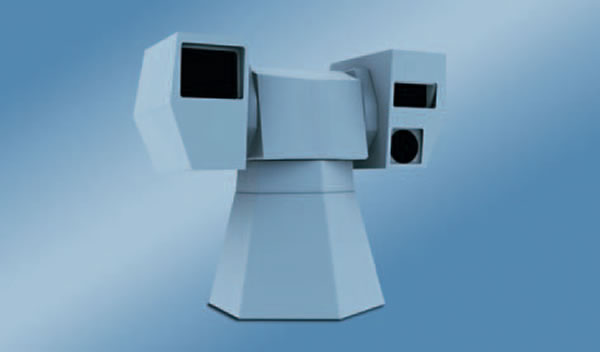
Rheinmetall will be equipping Malaysia with a total of twelve fire control radars (TMX/EO Mk2) and six electro-optical systems (TMEO Mk2) for six new patrol boats. This is a breakthrough order for a new generation of high-performance systems whose basic components were all developed by Rheinmetall.


TMX/EO Mk2 - Fire Control Radar
(Picture: Rheinmetall)


TMX/EO Mk2 - Fire Control Radar

The TMX/EO Mk2 can track air, surface and fixed ground targets with extreme precision. The size of the entire radar is reduced to a single unit located behind the antenna. It is available with either X-band or Ku-band radar and a scalable electro-optical sensor fit (including IR camera, TV camera and laser rangefinder). By means of a third axis between the lateral and elevation axes, the TMX/EO Mk2 is able to track steeply attacking targets, even in very rough seas.


TMEO Mk2 – Electro-Optical Tracking Module Mk2
(Picture: Rheinmetall)


TMEO Mk2 – Electro-Optical Tracking Module Mk2

The TMEO Mk2 is a modern, powerful and flexible tracking system intended for integration within a wide-range of naval fire control systems. Designed with a scalable architecture, the TMEO Mk2 can be employed in a wide variety of tactical roles, and optimised to meet specific functional requirements. The high quality TMEO Mk2 tracking data can be typically used for weapon control, as a 3-D designation source, and for internal data processing. The TMEO Mk2 will carry out the following primary operation functions, using both active and passive electro-optical sensors: anti air engagements, surface engagements and surveillance operations.

Together with spare parts and training, the order also includes a transfer of know-how to Malaysia, which will enable local industry to take an active part in the project. Delivery of the systems will commence in 2015 and continue through to 2020.

The Malaysian Navy’s new “Second Generation Patrol Vessels Littoral Combat Ships” (SGPV LCS), play a significant role in safeguarding regional sea lanes, where piracy poses a major threat to commercial shipping. Fire control technology from Rheinmetall will form a crucial element in the OPV’s shipboard technology, controlling the vessel’s primary and secondary armament. This important order underscores Rheinmetall’s increasing importance as a supplier of advanced technology to the world’s navies.


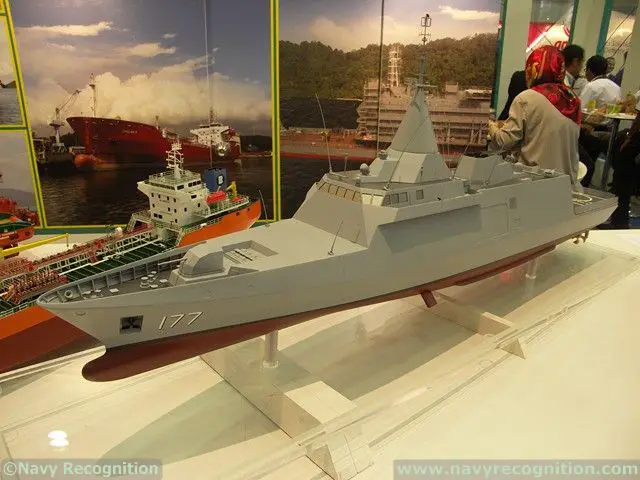
Gowind model at Boustead stand during DSA 2012
(picture: Navy Recognition)


Malaysian Shipyard Boustead, partnered with DCNS has been selected to supply six new corvette as part of the SGPV LCS program.

Specifications of the Boustead built vessels (as of now) are as follow:

Length: 107 meters
Breadth: 16 meters
Full load displacement: 2,730 tonnes
Max speed: 28 knots
Crew: 106
Range: 5,000 nm
Endurance: 21 days

DCNS Gowind combat. The RMN Littoral Combat Ships are based on this version
(Video: DCNS)

Integrated with SETIS, a combat system derived from FREMM, Gowind Combat can tackle air, surface and submarine threats. The shock-resistant platform (built according to military standards), the small radar cross-section together with an excellent acoustic signature make it a high-performance surface combatant.

Gowind Combat can be operated by a limited crew and has been designed to offer great at-sea availability and reduced life cycle costs.

source Navy Recognition
 

Another Armed Forces Asset Delivered On Schedule

I guess you can see the news on the launching of Gagah Samudera in the local defence blogs and articles in the newspapers especially since Utusan Malaysia front-paged the news. Mind you this is not the first combat ship built in Malaysia since MSE built the OPV KD Marikh and Hong-Leong Lurssen Shipyard built the six units of FAC-G Jerung class, The first that can be attributed to this shipbuilding is that it is the first training ship that is mission specific to the RMN as previously the Navy had to use their elderly warships to be converted to training ships while retaining their patrolling functions like the KD Rahmat and KD Tuah at the time. This was not conducive due the lack of space for the extra crewman and proper training facilities as highlighted when KD Tuah had to be deployed to the Gulf of Aden. That was the choice that had to be made as we could not afford actual Midshipmen Training Ships that the larger navies had in their fleets.


Credit : TLDM


Credit To Standupper @ Mymil Forum

Nonetheless inversely now the RMN can look forward to having their patrolling fleet strengthened after their small crafts were transferred to the MMEA as these training vessels can also be multi-rolled as basic OPVs although some may say their armaments are limited. Even the CNO in his speech below mentioned that these vessels are being looked at as the FAC replacements, though I believe they are actually actual replacement for the PB squadrons that was similarly lightly armed. But even though the dreaded by some FFNW word was not mentioned, I guess if the vessels are of modular construction, then it should not be a big issue to upgrade the vessels' armaments to full combat specifications.

Meanwhile, Aziz said the completion of the vessel had been long awaited by RMN not only to be used for training but also to patrol and monitor the country's waters.He pointed out that RMN had been waiting for the ship after 27 of its ships were transferred to the Malaysian Maritime Enforcement Agency in 2006. "At the moment, we only have K.D. Hang Tuah which is already 46-years old and KLD Tunas Samudera as training ships.

"We hope the government will take into account a proposal to procure another two ships from the company in the 11th Malaysia Plan as the two extra ships can replace RMN's eight fast attack vessels which are almost 40 years old," he said in his speech. - New Straits Time 15 December 2012

I must say thanks to the far-sighted person who decided to change the Navy's initial request for a mixed squadron of 47 metres and 30 metres training boats to these two Offshore Training Vessels as it allowed the Navy to have its cake and eat it too. And to those who doubt and criticise the Armed Forces projects as always being not to schedule, the Master Schedule below should prove that for this project it is on the right track, similar to the CSAR helicopter project. But I doubt this fact will receive much coverage from them.


Credit To Standupper @ Mymil Forum

source Secure Malaysia
 

Malaysia Becomes DCNS’ 1st Customer for Gowind Ships

In October 2010, Malaysia’s Boustead received a letter of intent from their government for 6 “second-generation patrol vessels.” In January 2012, South Africa’s DefenceWeb reported that DCNS and its local submarine & surface ship partner, Boustead Naval Shipyard, had won a contract worth $2.8 billion to supply 6 Gowind family ships to Malaysia, which would have been the type’s 1st paid order.


To win, DCNS reportedly beat Dutch firm Damen, whose scalable SIGMA ships have been purchased by neighboring Indonesia; as well as TKMS of Germany, who supplied Malaysia’s 6 existing MEKO 100 Kedah Class OPVs and its 2 Kasturi Class light frigates. Now these Gowind ships’ exact configuration, and equipment set is more certain – but the contract isn’t.

The Gowind Family & Malaysia’s Choices

The Gowind family isn’t a single design. It’s a family of ships with some common systems and design elements, designed to scale from inshore patrol needs to heavy corvette/ light frigate designs. DCNS has been exploring partnerships with lower-cost foreign shipyards as part of its overall export strategy, and had been negotiating with Bulgaria along those lines. Memoranda now give it footholds in South Africa as well as Malaysia.

All Gowind ships are shaped for stealth. The single central mast replaces several sensor masts in other ships, and provides both improved radar cross-section signature, and a 360-degree view for radars and other sensors. The ship’s propulsion system is based on Combined Diesel and Diesel (CODAD), but has no gas exhaust chimney to emit infrared plumes, channeling exhaust into the water-jets instead. Those water jets also create better maneuverability in shallow waters, and contribute to high-speed performance.

Gowind Control/120 Designs like FS L’Adroit , on loan to France for 3 years as a promotional exercise, are 1,100t offshore patrol vessels, with minimal armament. L’Adroit carries only a light autocannon and non-lethal weapons, for instance. Gowind Presence inshore patrol vessels are even smaller.

On the other hand, Bulgaria’s interest in Gowind ships involved fully-armed 2,250t Gowind Combat/200 corvettes, carrying 57mm guns, vertical-launch cells, anti-aircraft and anti-ship missiles, and a helicopter up to the 10-ton class.

Malaysia’s Gowinds

Subsequent reports from Navy Recognition indicated that Malaysia is interested in the Gowind Combat corvettes. Provisional specifications appear to make them the size of small frigates, only slightly smaller than the USA’s Littoral Combat Ship:

Length: 107 meters
Breadth: 16 meters
Full load displacement: 2,730 tonnes
Max speed: 28 knots
Crew: 106
Range: 5,000 nm
Endurance: 21 days

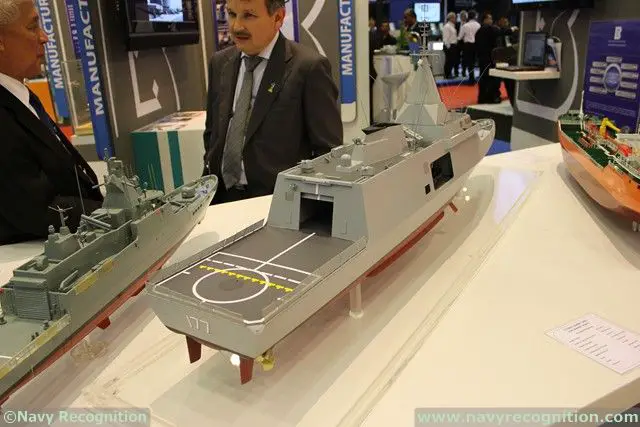
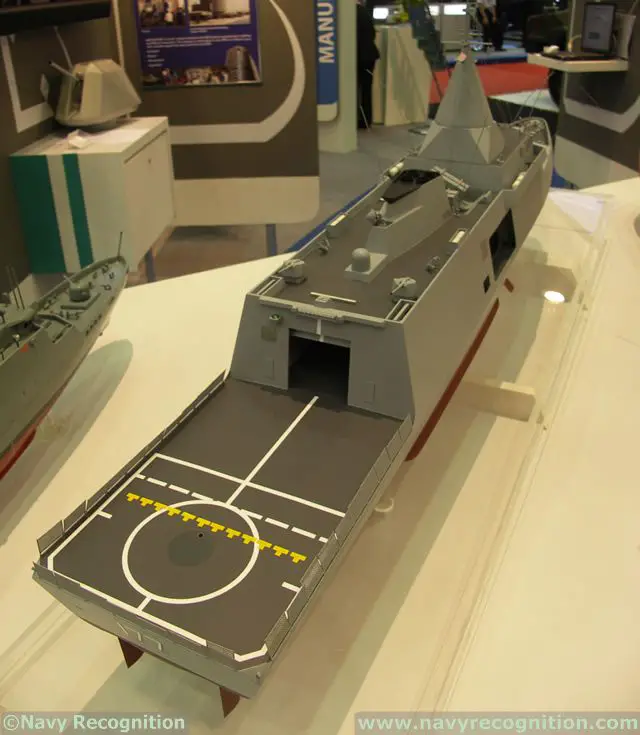
The ship models shown at a recent defense exhibition show a full helicopter hangar. Malaysia’s Navy currently flies the AgustaWestland Super Lynx 300 naval helicopter, and Eurocopter’s AS 350 Fennec light utility helicopter. With only 6 of each in stock, however, and other naval platforms (esp. Lekiu & Kedah Classes) that need them, Malaysia may need to buy or transfer new airframes, if they want the Gowind fleet to have their own on-board helicopters.

Key Sensors

Early indications are that DCNS’ preference for its SETIS combat system will win the day, over the Malaysian Navy’s reported preference for Thales’ Tacticos.
  • Thales SMART-S Mk2 3D multibeam radar
  • Rheinmetall’s TMEO Mk2 – TMX/EO Electro-optical tracking and fire control system
  • Thales Captas family for hull sonar
  • ASW suite with towed array sonar
Weapons Array

Pictures from DSA 2012 Defense exhibition in Kuala Lumpur appear to show 12 vertical launch cells, mounted behind the main gun. These will be DCNS’ Sylver family. Sylver A35 cells are the most likely choice, given the ship’s size and expected weapon fit.
  • BAE Bofors 57 mm Mk2 main gun
  • MBDA VL-MICA air defense missiles and their ACL containers in the Sylver cells
  • 8 of MBDA’s MM40 Exocet Block III anti-ship missiles mounted topside
  • 2 of MSI’s remotely operated 30mm guns on top of the helicopter hanger

Contracts & Key Events

Oct 25/12: A report from Euronaval says the contracts remain unfinalized, though DCNS CEO Patrick Boissier tells Lignes de defense that the existing Letters of Attribution have value even so. The project is expected to take place over 10 years or so, with a number of arrangements to finalize for production in Malaysia and in France. Lignes de defense [in French].

April 20/12: Navy Recognition personnel at the DSA 2012 Defense exhibition in Kuala Lumpur, Malaysia look at a Gowind model, and talk to an official from Boustead about the ships’ expected statistics and fit-out. See above for the ships’ expected fit-out, and see the article for pictures of the model.

The official added that, contra earlier reports, contract negotiations are still in progress. Navy Recognition | DCNS re: its exhibits.

Jan 17/12: DefenceWeb reports Malaysia’s selection of DCNS’ Gowind ships for a $2.8 billion contract. Deliveries are expected to run from 2017-2020, if all goes well.

The DefenceWeb report is very unclear concerning the exact type and fit-out for these ships, except to state that the shipbuilders wanted DCNS’ SETIS combat management system, while the Royal Malaysian Navy wants the Thales Tacticos systems already on one of Malaysia’s Kasturi Class light frigates. It did not state how this conflict was resolved.

source Defense Industry Daily
 

Singapore to start negotiations for 4 Scorpene SSKs with France's DCNS

According to rumors (infosdefense.com), the Republic of Singapore Navy is about to start negotiations with France for the possible purchase of 4 Scorpene class SSKs. The deal could include transfer of technologies. 

Contacted by Navy Recognition however, a DCNS source refused to comment on the rumors.

Scorpene class SSK of the Chilean Navy

About Scorpene class SSKs:
Already chosen by the Chilean, Royal Malaysian, Indian and Brazilian Navies Scorpene-Family submarines represent the state-of-the-art in submarine design and construction and benefits from the latest technologies developed for nuclear-powered classes operated by the French Navy, particularly as regards acoustic discretion and combat system performance. Scorpene can be fitted with an optional MESMA AIP section. 

- The MESMA (Autonomous Submarine Energy Module) is an electrical energy production module designed specifically for conventional submarines. As well as supplying electricity to the vessel and to the propulsion system, it can also be used to recharge the batteries without the need to surface. Together with a MESMA section, a Scorpene will be able to carry out extended missions with an over 3 weeks submerged endurance.

Link to Scorpene class datasheet.


Navy plan to buy more submarines

Kuala Lumpur: Aside from maintaining two Scorpene submarines, the Royal Malaysian Navy (RMN) plans to buy more submarines to boost the national's naval defence capability, said Navy chief Admiral Tan Sri Abdul Aziz Jaafar.

He said, however, the plan could not be implemented in the near term due to budget constraints while time was needed to train naval officers on the fundamental skills in submarine operations and gained the experience.

"The skills and experience are needed to ensure that the submarines can be operated safely and effectively," he told Bernama. The navy took delivery of two Scorpene submarines costing RM3.4 billion from France in 2009 and 2010.

Abdul Aziz said he was satisfied with the performance of both submarines after three years in operation to protect national waters from invasion and encroachment.

"I am proud to have received letters of commendation from distinguished guests, who have taken a dive on the submarines, including the Sultan of Terengganu Sultan Mizan Zainal Abidin, the Sultan of Selangor Sultan Sharafuddin Idris Shah and Penang Chief Minister Lim Guan Eng," said Abdul Aziz.

On the 78th Royal Malaysian Navy Day celebration tomorrow, he said the theme 'Innovative Personnel engender Transformation' manifested the navy vision to be a world-class entity through a culture of innovation.

Describing the challenges faced by the navy as "software and hardware", he said: "The first challenge is to retain skilled personnel in the service due to competition, and attractive and lucrative offers awaiting them in the corporate world.

"The second challenge is to maintain the level of preparedness of naval assets, especially involving aging assets as they are getting obsolete, and technological development."
On piracy threats especially in the Straits of Melaka, he said naval boats were intensifying patrols in identified hot spots besides conducting integrated operations jointly with maritime agencies from neighbouring countries. -- Bernama

Read more: Navy plan to buy more submarines - Latest - New Straits Times http://www.nst.com.my/latest/navy-plan-to-buy-more-submarines-1.77968#ixzz2O8S1DjSj
 

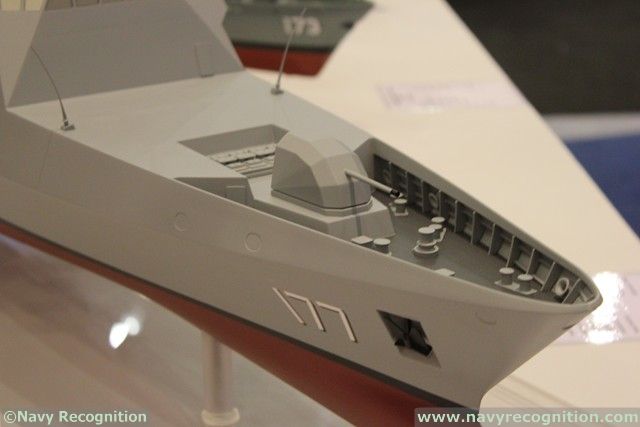
Boustead showcasing a DCNS Gowind corvette tweaked to Royal Malaysian Navy needs at DSA 2012

Navy Recognition team who was attending the DSA 2012 Defense exhibition in Kuala Lumpur, Malaysia was able to gather fresh information regarding the future Gowind corvettes of the Royal Malaysian Navy. While the negotiations are still ongoing, signature of the contract should happen soon according to an official from Boustead. The same person gave us an updated list of systems that will likely be found on those new corvettes.


Gowind model at Boustead stand during DSA 2012
(picture: Navy Recognition)

According to this source, the Gowind corvette for Royal Malaysian Navy will likely sports the following weapons:
  • Bofors 57 mm Mk 2 for main gun
  • MBDA Mica VL for air defense in the VLS cells
  • MBDA MM40 BlkIII anti-ship missiles
  • 2x 30mm guns from MSI-Defence Systems Ltd located on top of the helicopter hanger


Regarding sensors, the Malaysian Gowinds should come with:
TMEO Mk2 - TMX/EO Electro-optical tracking and fire control system by Rheinmetall
SMART-S Mk2 3D multibeam radar by Thales
Thales Captas for sonar (We could not get confirmation on the type: Nano or another model)

As expected, the combat managed system will be the SETIS by DCNS.


The generic Gowind designed by DCNS is a multi-mission corvette (100 metres, over 2,000 tonnes), A fully militarised platform, she has a comprehensive Mission Management System for full-scale multi-threat missions, including a complete ASW suite with towed array sonar and improved stealth and survivability.


Specifications of the Boustead built vessels (as of now) are as follow:

Length: 107 meters
Breadth: 16 meters
Full load displacement: 2,730 tonnes
Max speed: 28 knots
Crew: 106
Range: 5,000 nm
Endurance: 21 days

We were told however that these figures were subject to change (as well as the final hull design) depending on the final configuration picked by the Royal Malaysian Navy. First cut of the head of class is expect for early next year (2013).


Support : Creating Website | Johny Template | Mas Template
Copyright © 2011. MyDefTech - All Rights Reserved
Template Created by Creating Website Published by Mas Template
Proudly powered by Blogger